
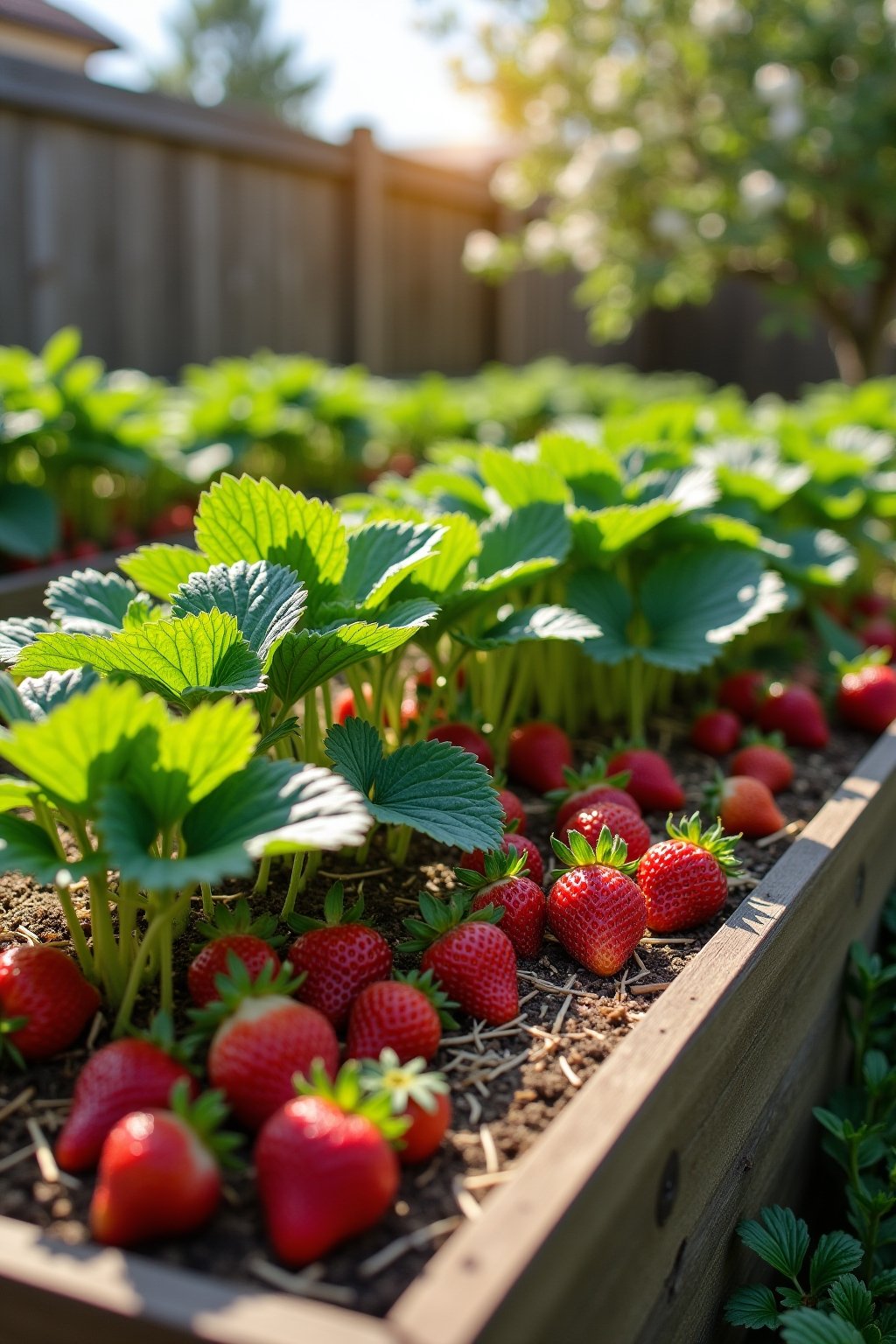
The first year I grew strawberries in a raised bed I did everything the seed packet told me. Plant 18 inches apart, mulch with straw, water regularly. By July my bed was a jungle of runners, a mat of leaves, and maybe two dozen small berries that mostly went to slugs. I stood there looking at my expensive cedar bed and thought, this is it, I am not a strawberry person.
What I did not know was that strawberries in a raised bed want a completely different setup than strawberries in the ground, and choosing the wrong variety will cost you 80% of your potential harvest before you plant a single plug. I rebuilt the bed the following spring with four specific changes and pulled 40 pounds of berries out of a 4×8 bed that summer. My kids ate strawberries for breakfast every day from June through September. This is exactly what I changed, the varieties I use now, and the planting system that makes a raised bed outperform anything you can grow in the ground.
Quick Facts
| Sun | Full Sun (at least 6-8 hours) |
| Difficulty | Easy with the right setup |
| Season | Plant March-May or September (timing depends on zone) |
| Zone | USDA zones 3-10 |
| Time to Harvest | 60-90 days for day-neutrals, next June for June-bearing |
Pull Out
- Cedar or galvanized raised bed, minimum 10-12 inches deep
- 25-30 bare-root strawberry plants for a 4×8 bed
- 40% topsoil, 40% compost, 20% coarse sand mix (about 32 cubic feet for 4x8x12)
- Balanced organic fertilizer (5-5-5)
- Straw mulch or pine needles
- Soaker hose or drip irrigation (strongly recommended)
- Bird netting and stakes
- Slug traps or copper tape
- Plant labels and a garden journal for variety tracking
Bed depth matters more than width. Strawberries are shallow-rooted but they rot fast in waterlogged soil. A 10-12 inch deep bed with a 40-40-20 soil mix gives perfect drainage and warmer soil (strawberries set more flowers in warm soil). Anything shallower than 8 inches dries out unpredictably. Anything deeper than 18 inches is wasted soil for strawberries — the roots rarely go past 6 inches.
Buy bare-root plants in bundles of 25. Online nurseries ship the healthiest stock at the lowest cost per plant. Expect to pay $20-35 for 25 plants of a single variety from Nourse Farms, Stark Bro’s, or a similar reputable shipper. Big box garden centers sell potted plants at 3x the price and often with poor variety labeling. Order by early February for spring delivery — the best varieties sell out.
Step 1: Choose the Right Variety Type (This Is Half the Battle)
Three types of strawberries exist and picking wrong costs you most of the harvest. June-bearing varieties produce one massive crop in June followed by nothing for the rest of the season. Everbearing gives two smaller crops in early summer and early fall. Day-neutral produces steadily from May through October.
For raised beds I plant day-neutrals. Steady berries for 5 months beat one big June rush every time. Albion and Seascape are the most reliable day-neutrals and keep producing through summer heat. San Andreas is another excellent choice with larger berries.
For 2025 look for the new UC Davis releases UC Golden Gate and UC Keystone. These are day-neutrals bred specifically for improved disease resistance and higher yields than the older standards. A few specialty nurseries had them available last spring for about $3 per plug.
If you genuinely love the flavor of classic June-bearers, plant Earliglow (best flavor in my opinion) or Honeoye (huge berries, cold-hardy). Just be ready for a short intense harvest window and quiet plants the rest of the season.
Step 2: Fill the Bed with the Right Soil
Strawberries fail in heavy clay and they fail in pure compost. They need a mix with drainage, fertility, and a slightly acidic pH (6.0-6.5). For a 4×8 foot bed that is 12 inches deep, you need about 32 cubic feet of soil — roughly 16 bags of 2-cubic-foot soil or one half-yard bulk delivery.
My reliable mix: 40% quality topsoil, 40% finished compost, 20% coarse sand or perlite for drainage. Work in a generous handful of balanced organic fertilizer (5-5-5) per square foot. If your soil tests above pH 6.5, add elemental sulfur or a layer of pine needles as natural acidifier.
Never use pure bagged “garden soil” without amendment — it compacts and suffocates strawberry roots. Never use unfinished compost — it burns the new roots and invites disease. Mix thoroughly and water the bed deeply 2-3 days before planting to settle the soil and activate the microbes.
Step 3: Pick Your Planting System (Matted Row vs. Hill)
Two planting systems exist for strawberries and the right one depends on your variety. Matted row is for June-bearers: plant 18 inches apart, let runners fill in to form a solid mat of plants, renovate the bed after harvest. Hill system is for day-neutrals and everbearers: plant 12 inches apart, remove all runners, focus the plant’s energy on fruit production instead of spreading.
For day-neutrals in a 4×8 raised bed, the hill system fits 24-28 plants. Space rows 14 inches apart, plants 12 inches apart within rows. This density gives each plant room to build a robust crown and full fruiting system without competing for light.
For June-bearing in a matted row, start with plants 18 inches apart and let the first-year runners fill in. A 4×8 bed starts with 12-15 plants and ends the season with 40+ plants. Matted rows need renovation every August — you mow or trim the leaves, thin the bed, and add fresh compost.
Step 4: Plant the Crowns at the Right Depth
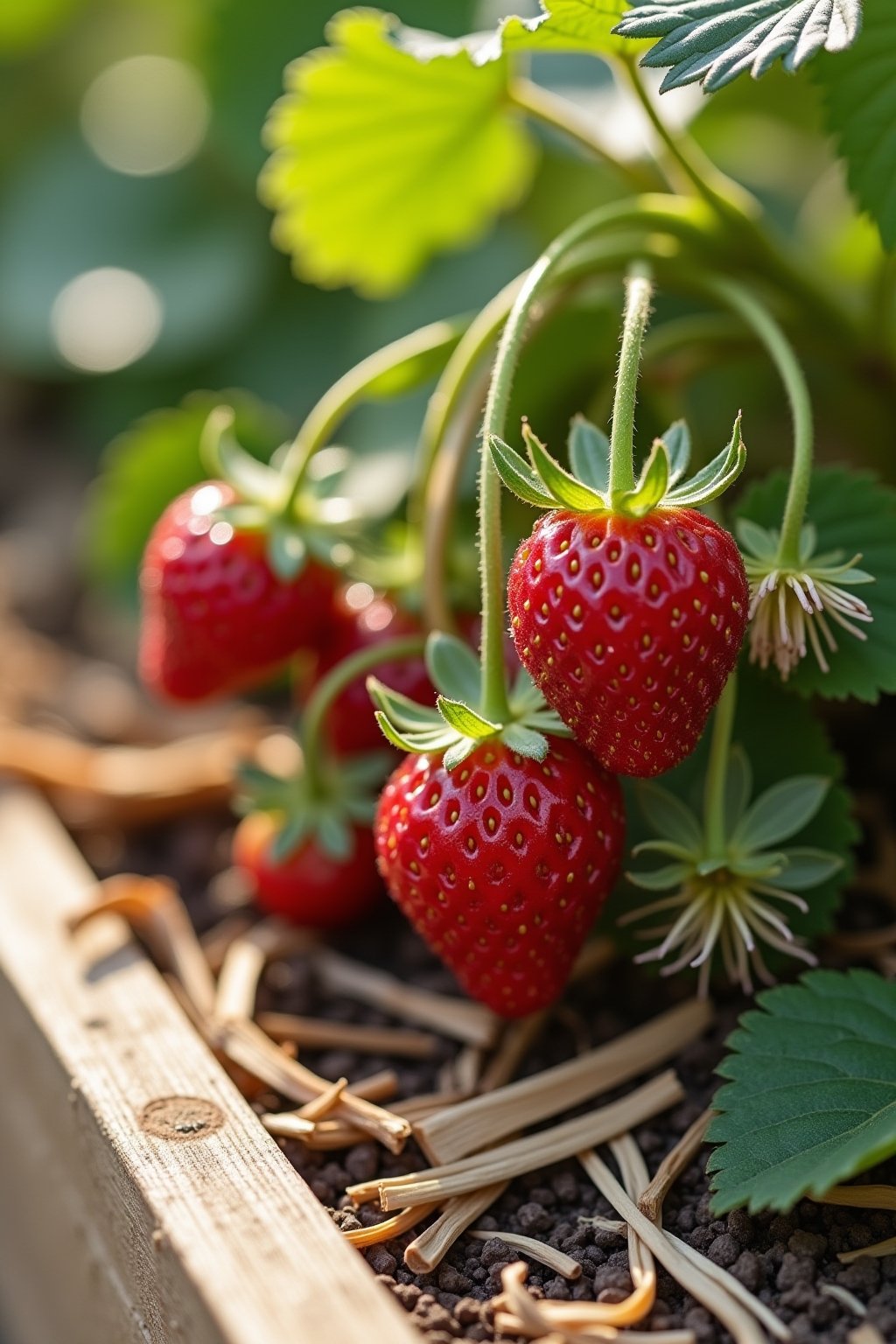
This single step is where most raised-bed strawberry failures start. The crown (where roots meet leaves) must sit exactly at soil level. Plant too deep and the crown rots. Plant too shallow and the roots dry out. Look at the color transition on the plant — pale where it was underground, green where it was above.
Dig a small hole, make a cone-shaped mound at the bottom, drape the roots over the mound in a fan shape, and backfill around the roots. The top of the crown should be right at the soil surface. Firm the soil gently — not packed, just settled.
Water thoroughly after planting, then water lightly every day for the first 10 days while the roots establish. A bare-root plant looks dead for about a week before it pushes its first new leaf. Do not give up on it — this is normal.
Step 5: Pinch the First Flowers (Year One Rules)
Every strawberry gardener I know has done this at least once: planted the bed in April, seen flowers forming by May, and thought great, berries coming soon. Then wondered in July why the plants are spindly and half the bed died by August. The answer is almost always that they let first-year plants fruit instead of forcing them to build roots.
Pinch off all flowers for the first 6 weeks after planting. For June-bearers, pinch all flowers in year one and take the first harvest in year two. For day-neutrals and everbearers, pinch flowers for 6 weeks and then allow fruit from July onward — this gives a small first-year harvest without sacrificing year two.
I know this feels painful. Do it anyway. A plant that fruits in year one produces 30-50% less total over its lifetime than a plant that was allowed to build a strong crown first. The math favors patience.
Step 6: Mulch, Water, and Protect
Straw mulch between plants does three critical jobs: holds moisture in the soil, suppresses weeds, and keeps developing berries off the soil surface where they rot in 48 hours. A 2-inch layer refreshed every spring is perfect. Pine needles work too and add mild acidity. Avoid hardwood mulch — it ties up nitrogen and slows the plants.
Water deeply and infrequently. A soaker hose or drip line delivering 1 inch per week is ideal. Avoid overhead watering once fruit forms — wet leaves invite disease and wet berries rot fast. In heat waves (over 90°F), water every other day and consider shade cloth for afternoon sun.
Birds and slugs are the two biggest strawberry thieves. Net the bed with 1-inch mesh as soon as the first berry colors up. Slug traps (saucer of beer works fine), copper tape around the bed edges, or iron phosphate bait control slugs without harming pollinators or pets.
Where Things Tend to Slip
Plants looking fine but producing tiny hard berries: Water stress during berry formation. Strawberries need consistent moisture from flower through ripening. Set up a soaker hose and check soil moisture twice a week. Mulch helps enormously.
Leaves turning yellow with green veins: Iron or manganese deficiency, usually from alkaline soil. Test pH — strawberries want 6.0-6.5. Apply elemental sulfur or top-dress with pine needles. New growth should green up within 4-6 weeks.
Fruit rotting on the plant (gray fuzzy mold): Botrytis, usually from wet weather or overhead watering. Remove affected berries immediately and discard — do not compost. Switch to soaker hose watering, improve airflow by removing some leaves, and keep ripe fruit picked every other day.
Plants wilting even though soil is wet: Root rot from waterlogged conditions. Your soil mix may be too heavy or drainage holes in the bed are blocked. Check that water drains freely after watering. In bad cases, dig up a plant and inspect roots — healthy roots are pale white, rotten roots are brown and mushy.
Bed producing great year one, terrible year two: Strawberry bed renovation was skipped. After June-bearing harvest, mow or trim the leaves to 3 inches, thin plants to 6 inches apart, add a layer of compost, and fertilize. Production rebounds the following year.
Seasonal Guide
Early spring (March-April): Prime planting window for bare-root plants. Plant as soon as soil can be worked. Pinch off all flowers for the first 6 weeks to force root development. Apply organic fertilizer and mulch.
Late spring (May-June): First flush of flowers on day-neutrals and everbearers (after pinching period). June-bearers peak this month with their single massive crop. Keep up consistent watering and net the bed against birds.
Summer (July-August): Peak harvest for day-neutrals and everbearers. Water daily in hot weather. Remove runners on hill-system beds. For matted-row June-bearers, this is the renovation window: mow leaves, thin plants, add compost.
Fall (September-October): Second flush of fruit on day-neutrals and everbearers. New plants can be set in zones 7-10 for a head start next spring. Remove dead leaves and apply a light compost top-dress.
Winter (November-February): In zones 3-6, cover the bed with 4-6 inches of straw after the ground freezes — insulates the crowns. Remove straw mulch in early spring when new growth starts. Order next year’s bare-root plants by February.
Useful Adjustments
- Pinch first-year flowers for 6 weeks — the single biggest lesson in strawberry growing. Plants with pinched flowers in year one produce 30-50% more total fruit over their lifetime than plants allowed to fruit immediately.
- Day-neutrals outperform June-bearers in raised beds — steady production for 5 months beats one big flush. Albion, Seascape, and San Andreas are the reliable ones. Watch for UC Golden Gate and UC Keystone (new 2025 releases) with better disease resistance.
- Plant crowns exactly at soil level — too deep rots the plant, too shallow dries out the roots. Look at the color transition on the plant: pale underground, green above. That line sits right at soil surface.
- Remove runners from day-neutral varieties — day-neutrals waste energy on runners that never fruit well. For June-bearers in a matted row, let runners fill in. For day-neutrals in a hill system, snip runners weekly to force fruit production.
- Mulch with straw or pine needles, never hardwood — straw keeps berries off the soil, pine needles add mild acidity, hardwood mulch ties up nitrogen and slows growth. A 2-inch layer refreshed each spring is perfect.
- Renovate June-bearing beds every August — mow leaves to 3 inches, thin plants to 6 inches apart, add compost, and fertilize. A June-bearing bed that is not renovated produces less every year and dies in year four.
- Replace the bed entirely every 4 years — strawberries accumulate soil diseases and crowns wear out. Rotate to a new bed or a new soil mix every 4 years for consistent long-term production.
Down This Path
- How to Grow Strawberries in a Vertical Tower (Massive Harvest, Tiny Footprint)
- How to Plant Blueberries in Containers (The pH Fix That Changes Everything)
Frequently Asked Questions
How many strawberry plants fit in a 4×8 raised bed?
In the hill system (day-neutrals), plan on 24-28 plants spaced 12 inches apart in rows 14 inches apart. In the matted row system (June-bearers), start with 12-15 plants 18 inches apart and let runners fill the bed — you will end the first season with 40+ plants. Either system produces 20-40 pounds of berries per year in peak seasons.
Should I plant June-bearing, everbearing, or day-neutral strawberries?
Day-neutrals are the best choice for raised beds because they produce steadily from May through October. Albion, Seascape, and San Andreas are reliable day-neutral varieties. June-bearers produce one massive flush in June and nothing else — great for preserving but leaves the bed idle most of the season. Everbearers give two medium-sized crops but day-neutrals outperform them in nearly every metric.
How deep should a raised bed be for strawberries?
10-12 inches deep is ideal. Strawberry roots rarely go deeper than 6 inches, so a 12-inch bed gives plenty of root room plus insulation during cold snaps. Shallower beds (under 8 inches) dry out unpredictably and cook the roots in summer heat. Deeper beds work fine but waste soil and money.
Why do I need to pinch off the first-year flowers?
Pinching off flowers for the first 6 weeks (or all of year one for June-bearers) forces the plant to build a strong crown and root system instead of fruiting. Plants that are allowed to fruit in year one produce 30-50% less total fruit over their 3-4 year productive lifetime. The short-term loss of a few berries in year one is paid back many times over in years two and three.
How long does a strawberry bed produce before needing replacement?
A well-maintained strawberry bed produces for 3-4 years before production drops significantly. Year two is typically the peak. By year four, accumulated disease pressure and crown wear reduce yields dramatically. The best practice is to rotate to a new bed or replace plants with fresh plugs every 3-4 years. You can also stagger your beds — plant a new bed every year so you always have a first-, second-, and third-year bed in production.
When is the best time to plant strawberries in a raised bed?
Early spring (March to May) is the main planting window for most US zones. Plant bare-root plants as soon as the soil can be worked and nighttime temperatures stay above 25°F. In warmer zones 7-10, fall planting (September to October) also works well and gives plants a head start for next spring. Avoid midsummer planting in any zone — heat stress kills bare-root plants fast.